

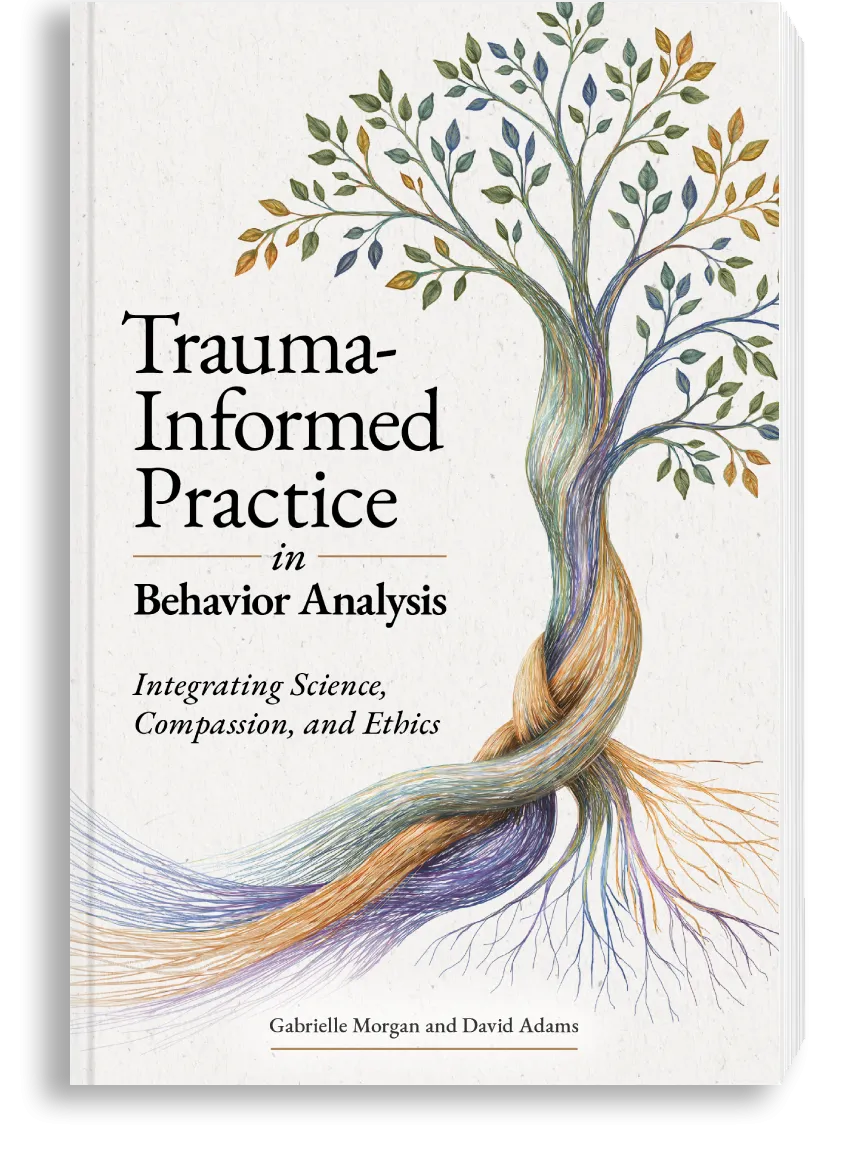
Coming November 17, 2026
Integrating Science, Compassion, and Ethics
“Is there something we are missing?” Have you asked this question while providing care? You’re not alone. We are only beginning to understand the far-reaching, complex effects of trauma on the individual. The impact of adverse experiences can profoundly influence even the best evidence-based approaches.
This timely book views applied behavior analysis (ABA) practices through the lens of trauma-informed care. It discusses the importance of compassion in applying the principles of behavior to learning histories shaped by adversity. Behavior analysts, educators, and allied professionals will find practical, effective strategies that are ethically grounded, culturally sensitive, and align scientific rigor with humane care. Practitioners will gain a deeper understanding of
• trauma-informed practice in behavior analysis (TIPBA)
• the potential effects of adverse childhood experiences on behavior
• the increased vulnerability to adverse events for people with developmental disabilities
• the risks of aversive interventions
• the impact and implications of neurobiological changes resulting from trauma
• ethical approaches to caring for people with trauma
• integration of TIPBA concepts into existing programs
Trauma-Informed Practice in Behavior Analysis is more than a resource. It is a call to fully incorporate practices that are evidence-based, deeply compassionate, and respectful to the individuals we serve.
Examine behavior analysis through a trauma-informed lens where compassion, science, and ethics converge to promote meaningful change for those with a history of adversity.
Behavior analysis stands at a defining crossroads. For decades, our science has demonstrated unmatched power in shaping behavior through precise, data-driven measures. As our understanding of trauma and neurobiology has deepened, our field has evolved. This transformation requires more than just technical skills; it necessitates a foundation of compassion, cultural humility, and a profound respect for human dignity.
Trauma-informed practice in behavior analysis (TIPBA) embodies this transformation by combining the precision of behavioral science with the relationships, safety, and sensitivity essential for individuals whose lives have been marked by adversity. We need to continue to embrace a practice focused on compassionate care in order to best serve our clients and those we supervise, and to change outdated views of behavior analysis as strictly rigid and compliance driven.
About the Authors

Gabrielle Morgan, PhD, BCBA-D, is an associate professor of ABA at Bay Path University in Massachusetts and organizer of its annual Trauma-Informed Practice in ABA conference. She researches and presents on integrating trauma-informed approaches into behavior-analytic practice.

David Adams, PsyD, LPCC, BCBA-D, is the president of New Life Psychology Group in Southern California. He is a Board Certified Behavior Analyst®, licensed psychologist, part-time professor of ABA at National University, and expert trainer with Foster Care Kinship Education at Saddleback College.
Keep Me Updated on Trauma-Informed Practice in Behavior Analysis
Praise for Trauma-Informed Practice in Behavior Analysis
Gregory P. Hanley
"From the concept of social validity to the development of our professional code of ethics, behavior analysts have long recognized that a powerful behavior-change technology must be used responsibly. In this timely and thoughtful book, the authors present a clear framework for helping without harming by integrating the core principles of trauma-informed care into behavioral assessment and treatment. It is essential reading for any behavior analyst who wants to build stronger connections with their clients and offer them greater protection."
— Gregory P. Hanley, PhD, BCBA-D
Executive Director of Compassionate Care, Action Behavior Centers
CEO, Founder, FTF Behavioral Consulting
Camille Kolu
"From the smash-up of foster parent and psychologist David Adams and doctoral-level Board Certified Behavior Analyst and accomplished educator Gabi Morgan comes this treasure of a book. It reads like a manual for integrating trauma-informed practice into one’s behavior analysis practice, from the initial interview with a family to all the resulting assessment and collaboration that will be richer after reading this book. Stories and scenarios enliven chapters rich with the authors’ practical experience across classrooms, clinics, and living rooms. Whether you’re looking for a way to approach collaboration with a client’s medical providers, better understand the neurobiology of trauma, or apply behavior analysis in more compassionate ways—you’ve found it."
— Camille Kolu, PhD, BCBA-D
Owner, Cusp Emergence
Michael J. Cameron
"I have a serious reason for endorsing Trauma-Informed Practice in Behavior Analysis. Understanding trauma and the sequelae of trauma is a necessary part of third-wave behavior analysis. Another reason is that the book makes clear why, as clinicians, we need to read diversely and understand behavior from an interdisciplinary perspective, including neurobiology. I have a third reason: The book provides practical guidance, from assessment through clinical support. If these reasons are not enough, I recommend the book because it reminds us of something fundamental: Our science of human behavior is in service to humanity. Humanity is not in service to behavioral science. The person comes first. To Board Certified Behavior Analysts®, whether early in your careers or well into them: Take note."
— Michael J. Cameron, PhD, BCBA-D, LBA
Adjunct Professor, University of Southern California
Kimberly Crosland
“A vital and timely resource for behavior analysts! This book effectively integrates trauma-informed care with the science of applied behavior analysis, serving as an essential guide for delivering safer, more compassionate, and truly individualized care."
— Kimberly Crosland, PhD, BCBA-D
Professor, University of South Florida
Kristin M. Kosmerl
"Trauma-Informed Practice in Behavior Analysis: Integrating Science, Compassion, and Ethics provides a timely, accessible framework for understanding adverse childhood experiences through an applied behavior analysis (ABA) lens. It guides professionals and caregivers in delivering compassionate and ethical ABA that prioritizes assent and client dignity."
— Kristin M. Kosmerl, EdD, MEd, BCBA-D, BCASE, IBA, CTP, ACAS, ADHD-CE, CYMHS, LBA, LBS
Dr. Kosmerl Consulting, LLC
Mary Jane Weiss
"This is a book that is very much needed at this time, and that presents a comprehensive introduction to a topic that has garnered much enthusiasm in the realm of behavior-analytic practice. The authors have discussed essential definitional issues associated with the integration of trauma-informed care (TIC) into behavior-analytic work, helping practitioners to understand its relevance to service provision and its congruence with behavior-analytic frameworks. The authors outline practices that incorporate a trauma-informed lens within assessment and intervention contexts, highlighting the individualized approach that is the heart of behavior-analytic work. In this way, they align the tenets of TIC with the foundations and approaches of applied behavior analysis. Additional helpful elements include information on interdisciplinary intersections, including from the fields of neuroscience and psychology. Finally, the integration of other movements within behavior analysis that highlight the commitment to humane and compassionate care is timely and instructive; in particular, the information on culturally responsive intervention and assent-based practices will help practitioners develop a comprehensive understanding of this skill set. This represents a real contribution to the evolution of thought and practice within TIC and helps behavior analysts move from aspiration to implementation of these values-based practices."
— Mary Jane Weiss, PhD, BCBA-D, LABA
Dean of the Institute for Applied Behavioral Science
Director, PhD Program in Applied Behavior Analysis
Endicott College
Dennis Dixon
"Trauma-Informed Practice in Behavior Analysis offers a thoughtful and practical bridge between the science of behavior analysis and the growing emphasis on care that is compassionate, ethical, and individualized. Morgan and Adams show that being trauma informed does not require us to move away from behavioral science, but rather to apply it more fully and realize its potential to improve the lives of the people we serve."
— Dennis Dixon, PhD
Chief Clinical Officer, 360 Behavioral Health
Ellie Kazemi
“Trauma-informed practice reminds us that effective behavior analysis depends not only on what we do but on how we build trust, listen, and respond within relationships. Morgan and Adams draw from their meaningful clinical experiences and offer an important contribution to a growing conversation about trauma-informed care. They provide particularly useful frameworks for thinking about safety, choice, and connection. Their attention to culture and supervision also points toward areas our field must continue to develop as we prepare behavior analysts to bring relational skill and cultural responsiveness to both clinical practice and the supervision of others.”
— Ellie Kazemi, PhD, BCBA-D
Professor, California State University, Northridge
Saundra Bishop
“This is THE resource I wish I had when I started my trauma-informed ABA journey over 15 years ago. This book is easy to understand, is research based, has helpful examples, and provides tangible ways to apply the principles covered. I'm so glad a comprehensive resource like this finally exists!"
— Saundra Bishop, MS, BCBA, CCT
Beyond the BASICS
Author of The Trauma-Informed Behavior Management Handbook
Amanda Hineline
"Behavior never occurs in a vacuum, and understanding function is only part of understanding the person in front of us. Trauma-Informed Practice in Behavior Analysis brings attention to a necessary and long-overdue conversation within our field about how trauma, adversity, and learning history can inform how we understand and respond to behavior. This work offers an important bridge between behavioral science and the compassion, context, and curiosity needed to better serve the whole person.”
— Amanda Hineline, MEd, BCBA, LBA